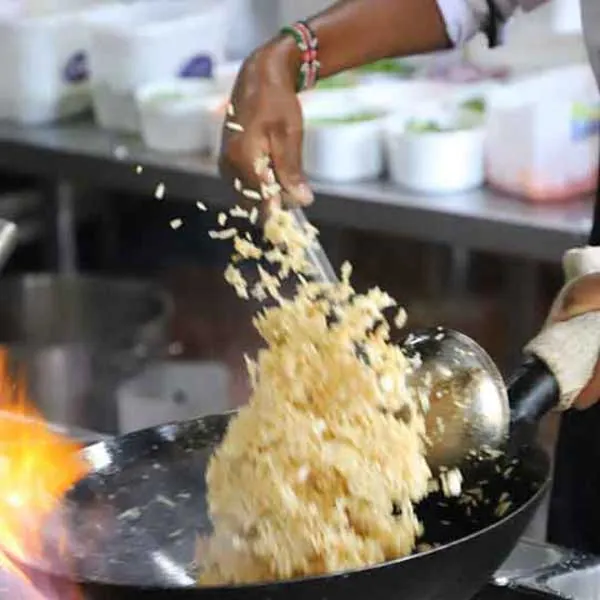
Understanding why the food tastes the way it does begins with understanding the physics of how it was made.
I. The Seasoned Surface
A carbon steel wok is not a pan. That distinction is not semantic — it is structural. Over months and years of use, the interior surface of a carbon steel wok develops a polymerized oil layer: cooking oil, driven into the steel's microscopic pores by repeated high-heat cycles, oxidizing and carbonizing into a patina that is simultaneously non-stick, heat-conductive, and chemically reactive in ways that bare metal is not.
This is not coating. It is not Teflon. It is not a manufactured surface applied in a factory. It is the accumulated record of every meal the wok has ever made — a living interface that food scientists classify as a seasoned surface and that any experienced cook would describe more simply as memory.
The wok remembers. Each cycle of heat and oil adds another molecular layer, darkening the steel, narrowing the surface pores, making the boundary between metal and ingredient more precise and more responsive. A new wok cannot produce the same food as one that has been in continuous service for five years. The surface is too young. It has not yet developed the thermal characteristics that come from ten thousand meals. The Mister Wok woks are not new.
II. The Heat Gradient
A domestic gas hob delivers approximately three to five kilowatts of heat through a single burner ring. The flame is uniform, circular, and distributed across the base of the pan. There is one temperature zone: whatever the burner produces.
An industrial wok burner operates on a different architecture entirely. At its centre — the blast zone — the metal surface temperature exceeds 300°C, sometimes reaching 350°C at peak loading. The outer rim of the wok, away from the central blast, sits 80 to 120°C cooler. This differential is not a manufacturing flaw. It is the design.
A cook who understands the wok uses both zones simultaneously. Proteins go to the centre — flash-seared at maximum temperature, crust forming in seconds. Aromatics — the garlic, the ginger, the spring onion — are held at the edge, alive and fragrant, warmed but not incinerated. Final assembly travels across both zones in a single motion. The food experiences two different thermal environments within the space of one pan and thirty seconds. No domestic hob can create this gradient. The single-zone limitation of a home burner is not a matter of technique — it is a hard constraint of the hardware.
III. Wok Hei — The Breath of the Wok
Wok Hei is frequently mistranslated as smoky flavour. It is more chemically specific than that.
When cooking oil contacts a wok surface at 300°C and above, it does not simply heat. It partially aerosolizes — fine oil droplets become airborne in the convective column above the flame, briefly combust in contact with the burner, and deposit as oxidized lipid compounds back onto the surface of the food. This is the chemistry of Wok Hei: not passive smoke but a flash of controlled combustion, measurable in milliseconds, that leaves a distinct chemical signature on every protein and carbohydrate it touches.
The Maillard reaction operates at wok temperatures not over minutes but over seconds. The result is a crust that forms before the interior protein has time to tighten. Tender inside. Seared outside. A textural outcome that should not, by the logic of slower cooking, be possible.
It is possible because of thermal mass. The industrial wok — thick carbon steel, preheated continuously through a full service — carries sufficient stored heat to absorb the temperature drop of cold, wet ingredients and recover to operating temperature within seconds. A thin domestic pan loses 50 to 80°C on contact and cannot recover fast enough. The food releases moisture. The moisture converts to steam. The steam drops the surface below the Maillard threshold. The crust does not form. The Wok Hei window closes before it has opened. This is not a failure of technique. It is a failure of infrastructure.
IV. Kinetic Rhythm
The toss is not theatrical. It is a mechanical input with a specific thermal function.
When a cook lifts and returns the wok in the characteristic forward-up-back motion, the food follows a calculated arc. Every ingredient briefly leaves the metal surface, passes through the superheated air column above the blast zone, and returns to a different contact point on the pan. This rotation serves two simultaneous purposes: it ensures even exposure to the maximum-temperature zone, and it prevents surface moisture accumulation that would drop the pan below the Maillard threshold.
This is kinetic rhythm — a repeated, calibrated mechanical input that maintains the thermal and moisture conditions necessary for correct cooking. Noodles take three passes. Proteins take two. Vegetables, depending on cell density and water content, take one pass at centre and one at the edge. The sequence is not purely instinct. It is a learned mechanical process, refined through repetition, governed by the physics of heat transfer and the chemistry of the ingredients in the pan. The motion is as purposeful as a machinist's cut. It looks simple because it has been performed correctly ten thousand times.
V. Craft Versus Showmanship
There is a category of restaurant that has turned the wok into scenery. Open kitchens with jets of controlled flame, dramatic tosses timed for the dining room, fire that rises not because the thermal process demands it but because the guest has been conditioned to expect it. The wok functions in these settings as a prop — the spectacle of technique substituted for its substance.
The chemistry of Wok Hei is indifferent to observation. It requires the correct surface temperature, the correct oil aerosolization conditions, and the correct kinetic input at the correct moment. These are quiet variables. They produce no visible drama. The result arrives in a bowl: a crust on the chicken that should not coexist with the tenderness of the interior, a fried rice where each grain of aged long-grain aromatic rice is separate and carries a faint carbonized depth that reads as complexity rather than damage. We do not cook for the fire-show. We cook for the chemical result. The distinction is apparent only when you eat the difference.
The Infrastructure Argument
You cannot install an industrial wok burner in a residential kitchen. The gas supply infrastructure does not support it. The ventilation required to handle aerosolized oil at operating volume exceeds domestic building codes. The thermal mass of a carbon steel wok preheated through a full service cannot be approximated by equipment purchased from a homeware shop.
This is not a criticism of home cooking. It is a different discipline operating under different constraints, producing different and entirely valid results. It is simply an explanation of why the food at Mister Wok tastes the way it does, and why it tastes different everywhere else.
The infrastructure exists at three addresses in Nairobi. The seasoned surface is ready. The blast zone is at temperature. The kinetic rhythm begins the moment the order arrives.