What the Selection Criteria Are
Most rice is selected and sold at its freshest. Fresh rice has high moisture content, high surface starch, and high gelatinisation potential — characteristics that make it excellent for steaming and for absorbing sauce. These same characteristics make it the wrong rice for a wok.
At Mister Wok, the rice used across every fried rice dish on the menu — from Plain Fried Rice to the Shrimp Egg and Chicken Yong Chow Rice — is an aged aromatic long-grain variety selected specifically for its behaviour under high-heat wok conditions. The selection is not a matter of flavour preference. It is a technical specification.
Why Age Changes the Grain
Rice loses moisture as it ages. This is generally considered a storage problem. In the context of wok cooking, it is a performance specification.
A grain of fresh rice carries approximately 13 to 14 percent moisture content by weight. An aged grain, stored correctly over six months to a year, drops below 12 percent. That two percent difference does not sound significant. At 300°C, it is the difference between a grain that steams and a grain that sears.
When high-moisture rice enters a hot wok, the surface water flashes to steam before the Maillard reaction can occur. The grain softens before it colours. The exterior never develops the faint carbonised depth that distinguishes correctly made fried rice from rice that was merely heated with other ingredients.
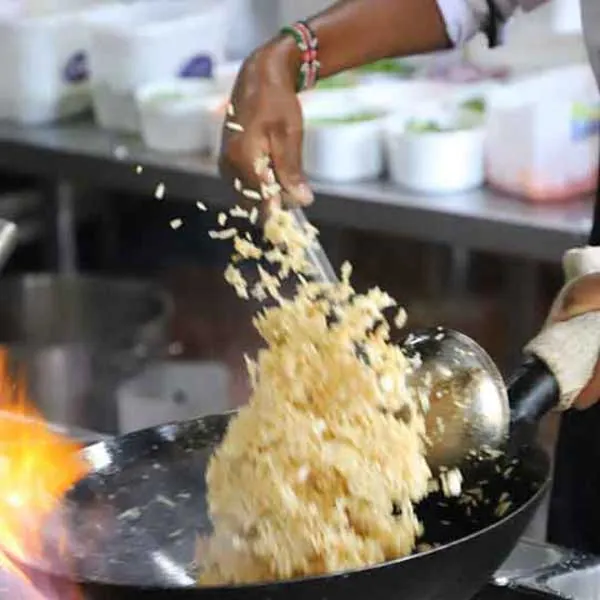
The aged grain enters the wok dry. The surface contacts the metal at operating temperature. The Maillard reaction begins within seconds. The exterior sets before the interior loses its structure. The grain stays separate because there is no surface moisture binding it to its neighbours.
The Separation Standard
The benchmark of a correctly fired fried rice is grain separation. Every grain independent. No clumping. No starch paste binding the mass together. Each piece of egg distinct. Each fragment of protein sitting alongside the grain rather than fused to it.
This standard is not achievable with fresh rice regardless of technique. A skilled cook using fresh rice will produce a competent dish. They will not produce grain separation at this level, because the physics do not allow it. Surface moisture binds. Steam softens. The window for correct searing closes before it opens.
Technique and Grain as Co-Dependents
The wok technique — the blast zone, the kinetic rhythm, the thermal mass of preheated carbon steel — was developed in conjunction with aged rice, not independently of it. Chinese wok cookery evolved around aged long-grain precisely because the technique demands it.
A cook who understands the wok and uses the wrong rice is operating half a system. The equipment and the motion are present. The raw material cannot respond correctly. The result will be edible and it will fall short of what the technique is designed to produce. This is why the grain does not change. It is not a premium ingredient in the decorative sense. It is a functional component of the dish. Changing it changes the dish.
What This Means at the Table
The guest does not need to know any of this to appreciate the result. The separation is visible before the first forkful. The texture is apparent in the first bite — each grain with its own integrity, the slight resistance that comes from a correctly seared exterior, the faint char that reads as depth rather than damage.
This is what correct wok fried rice tastes like. It tastes like a decision made at the supply level, enforced through technique, and delivered at 300°C.